

AI TOOLS FOR VIDEO
Transforming the Future of Video Creation

Video has become one of the most powerful forms of communication in the digital age. From social media platforms and online education to digital marketing and entertainment, video content dominates the internet. Businesses use videos to promote products, educators use them to teach complex ideas, and creators use them to tell stories and build communities.
However, producing high-quality videos traditionally requires specialized skills, expensive equipment, and time-consuming editing processes. Video production often involves scripting, filming, lighting, sound design, editing, visual effects, and distribution. For many individuals and small businesses, these requirements create significant barriers to creating professional video content.
Artificial Intelligence (AI) is transforming this landscape. AI-powered video tools are making video creation faster, easier, and more accessible than ever before. With AI, users can generate videos from text, automatically edit footage, create animations, enhance video quality, and even generate realistic virtual presenters.
These technologies allow creators to produce professional-looking videos without needing advanced technical knowledge or large production budgets.
In this article, we explore AI tools for video, how they work, their key features, benefits, real-world applications, challenges, and the future of AI-powered video production.
Understanding AI Video Tools
AI video tools are software platforms that use artificial intelligence and machine learning algorithms to automate various aspects of video production.
instead of manually editing every frame of a video, users can rely on AI systems to perform tasks such as:
- Generating videos from written text
- Automatically editing video clips
- Creating animations and motion graphics
- Enhancing video resolution and quality
- Generating voiceovers and subtitles
- Creating AI avatars or presenters
These tools are powered by advanced machine learning models trained on large datasets of videos, images, and audio recordings. Through training, AI systems learn how videos are structured and how visual and audio elements interact.
By applying this knowledge, AI can generate and edit videos efficiently while maintaining professional quality.
The Technology Behind AI Video Creation
AI video tools rely on several advanced technologies that work together to automate and enhance video production.
Machine Learning and Neural Networks
At the core of AI video tools are neural networks—complex algorithms designed to mimic how the human brain processes information.
These networks are trained on massive collections of video footage and learn patterns related to motion, lighting, transitions, and storytelling structures.
Once trained, these models can perform tasks such as identifying objects, recognizing speech, and generating video sequences.
Generative AI
Generative AI models can create new content from scratch. In video production, generative models can transform written prompts into animated scenes, generate characters, or produce visual backgrounds.
For example, a user might enter a prompt like:
“Create a 30-second promotional video for a coffee shop with warm lighting and relaxing music.”
The AI can generate visual scenes, transitions, and audio elements that match the description.
Computer Vision
Computer vision enables AI systems to analyze and interpret visual content within video frames. It allows AI to detect faces, objects, movement, and scene changes.
This technology is essential for features such as:
- Automatic scene detection
- Object tracking
- Facial recognition
- Background replacement
Computer vision helps AI tools edit and enhance videos intelligently.
Natural Language Processing (NLP)
Natural language processing allows AI tools to understand written or spoken language.
This capability enables features like:
- Generating video scripts
- Creating subtitles and captions
- Converting text into narrated videos
- Translating videos into different languages
By combining NLP with video generation technology, AI tools can transform written content into complete video presentations.
Key Features of AI Video Tools
AI video platforms offer a variety of features designed to simplify video production and make professional-quality content accessible to more users.
Text-to-Video Generation
One of the most exciting innovations in AI video technology is text-to-video generation. Users can type a description or script, and the AI automatically generates a video based on that input. The tool selects visuals, animations, transitions, and voiceovers to match the content.
Text-to-video tools are especially useful for:
- Marketing videos
- Educational content
- Explainer videos
- Social media clips
This capability dramatically reduces the time required to create videos.
AI Video Editing
AI editing tools can automatically analyze raw footage and create a polished video by selecting the best clips, trimming unnecessary sections, and adding transitions.
AI editors can also:
- Adjust color and lighting
- Stabilize shaky footage
- Add background music
- Sync audio with visuals
These features simplify the editing process and help users produce professional videos quickly.
AI Avatars and Virtual Presenters
Some AI video tools allow users to create virtual presenters or avatars that speak on screen. These avatars can deliver scripted messages, presentations, or training materials. Users simply type the script, and the AI generates a video of a digital presenter speaking the text.
This feature is widely used for:
- Online courses
- corporate training
- marketing videos
- multilingual communication
Automatic Subtitles and Translation
AI video tools can automatically generate subtitles and captions by transcribing spoken audio. Advanced platforms can also translate subtitles into multiple languages, making content accessible to global audiences.
This feature is particularly valuable for:
- YouTube creators
- educators
- international businesses
Video Enhancement and Upscaling
AI-powered enhancement tools can improve the quality of video footage by increasing resolution, sharpening details, and reducing noise. Older or low-resolution videos can be restored and improved using AI algorithms. This capability is valuable for media restoration and professional video production.
Background Removal and Scene Generation
AI can automatically remove or replace video backgrounds without requiring green screens. Users can place themselves in different environments, such as offices, classrooms, or scenic landscapes. This feature is commonly used in virtual presentations and content creation.
Best AI Tools for Video Creation
AI video technology has advanced rapidly in recent years, and several powerful platforms now allow creators to produce professional-quality videos with minimal effort. These tools are widely used by marketers, content creators, educators, and businesses looking to scale their video production. Below are some of the most popular and effective AI video tools currently available.
Best AI Video Tools Compared
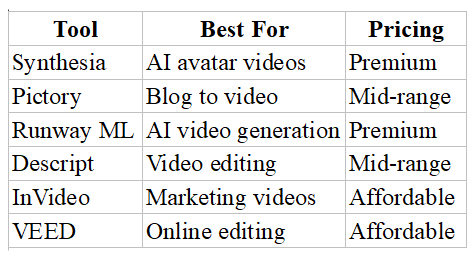

1. Synthesia
Synthesia is one of the most well-known AI video generation platforms. It allows users to create professional videos using realistic AI avatars that speak directly to the audience.
Instead of recording yourself on camera, you simply type your script, choose an avatar, and the platform generates a fully produced video.
Key features include:
- 140+ AI avatars
- 120+ languages and voices
- Custom avatars for businesses
- Screen recording and presentation tools
- Easy script-based video creation
Synthesia is widely used for:
- corporate training videos
- marketing presentations
- product tutorials
- educational content
For affiliate marketers, Synthesia is particularly attractive because many businesses are looking for scalable video production solutions.
✅ Find out more about Synthesia

2. Pictory
Pictory is a powerful AI platform designed to transform written content into engaging videos automatically.
Bloggers and marketers often use Pictory to convert articles into short videos that can be shared on social media or video platforms.
Key features include:
- Convert blog posts into videos
- Automatic caption generation
- AI voiceovers
- Stock footage library
- Automatic scene selection
Pictory is especially useful for:
- repurposing blog content
- creating social media videos
- YouTube content automation
For affiliate marketers, this tool fits perfectly with content repurposing strategies.
✅ Find out more about Pictory

3. Runway ML
Runway ML is one of the most advanced AI video creation platforms available today. It provides powerful tools for generating and editing video using artificial intelligence.
The platform is popular among filmmakers, designers, and digital artists.
Key capabilities include:
- text-to-video generation
- AI video editing tools
- object removal from videos
- background replacement
- motion tracking
Runway ML is frequently used for:
- creative video production
- film and visual effects
- experimental digital art
As AI-generated video becomes more sophisticated, platforms like Runway ML are leading the innovation.
✅ Find out more about Runway

4. Descript
Descript is an AI-powered editing tool that allows users to edit video by editing text.
The software automatically transcribes your video, and you can simply delete or modify text to edit the video.
Key features include:
- automatic transcription
- text-based video editing
- AI voice cloning
- filler word removal
- podcast and video editing tools
Descript is widely used by:
- podcasters
- YouTubers
- online course creators
- interview editors
Its unique workflow dramatically simplifies the editing process.
✅ Find out more about Descript

5. InVideo
InVideo is a user-friendly AI video creation platform that helps users produce marketing videos quickly.
It offers thousands of templates designed for social media, advertising, and promotional content.
Key features include:
- AI script generator
- pre-made video templates
- stock media library
- drag-and-drop editing
- automated voiceovers
InVideo is particularly popular among:
- social media marketers
- small business owners
- YouTube creators
The platform makes video production accessible even to beginners.
✅ Find out more about Invideo

6. VEED.io
VEED.io is another powerful AI video platform that focuses on simplicity and automation.
It provides an intuitive interface that allows users to create and edit videos directly in the browser.
Key features include:
- automatic subtitles
- AI voiceovers
- video translation
- screen recording
- social media video templates
VEED is widely used by:
- YouTubers
- educators
- marketing teams
- startups
Its automation features make video editing extremely efficient.
✅ Find out more about Veed.io
How to Choose the Right AI Video Tool
With so many AI video platforms available, selecting the right one depends on your goals and content strategy.
Here are some quick recommendations:
- Best for AI avatar videos: Synthesia
- Best for turning blog posts into videos: Pictory
- Best for advanced AI video generation: Runway ML
- Best for editing podcasts and interviews: Descript
- Best for marketing and social media videos: InVideo
- Best for beginners and quick editing: VEED
If you are building a content marketing strategy, many creators actually use multiple tools together to maximize efficiency.
Challenges and Ethical Considerations
While AI video tools offer many benefits, they also raise important challenges and ethical concerns.
Deepfake Technology
AI video technology can be used to create realistic fake videos, sometimes known as deepfakes.
These manipulated videos can potentially spread misinformation or damage reputations.
Developers are working on detection systems and safeguards to address these risks.
Copyright and Ownership
Questions about ownership of AI-generated videos are still evolving.
When AI generates visual elements based on training data, determining who owns the final content can be complex.
Clear guidelines and regulations may emerge as the technology matures.
Authenticity and Trust
As AI-generated videos become more realistic, viewers may find it harder to distinguish between real footage and generated content.
Transparency and responsible use will be essential to maintain trust.
Quality Limitations
Although AI video tools are improving rapidly, some outputs may still lack the creative nuance of professionally produced videos.
Human creativity and storytelling remain essential for high-quality content.
Best Practices for Using AI Video Tools
To get the most value from AI video tools, users should follow several best practices.
Start with a Clear Script
Even when AI generates visuals automatically, a strong script or message is essential for an effective video.
Planning the story or message improves the final result.
Review and Edit AI Outputs
AI-generated videos should always be reviewed and refined. Small edits can improve clarity, pacing, and visual quality.
Human oversight ensures that the final product meets professional standards.
Combine AI with Traditional Production
Many creators use AI tools alongside traditional filming and editing methods.
This hybrid approach allows them to combine automation with creative control.
Use AI Responsibly
Users should avoid misleading audiences with deceptive AI-generated content.
Ethical use of AI will help maintain credibility and trust.
The Future of AI Video Creation
AI video technology is evolving rapidly, and the future promises even more advanced capabilities.
Real-Time Video Generation
Future AI tools may generate videos instantly as users type or speak instructions. Creators could collaborate with AI in real time to develop visual stories.
AI-Generated Movies and Animation
Advances in generative AI may eventually allow creators to generate entire animated films or short movies using simple prompts.
This could dramatically lower the barriers to filmmaking.
Personalized Video Content
AI systems may generate personalized videos tailored to individual viewers.
For example, marketing videos could automatically adapt to different audiences based on preferences or demographics.
Integration with Virtual Reality and 3D Worlds
AI video tools will likely integrate with virtual reality, augmented reality, and 3D environments.
Creators may generate immersive experiences and interactive videos using AI technology.
Conclusion
AI tools for video are revolutionizing how video content is created, edited, and distributed. By automating complex production tasks, these tools allow individuals and businesses to produce professional-quality videos quickly and affordably.
From marketing campaigns and social media content to online education and corporate training, AI-powered video tools are expanding the possibilities of visual storytelling.
While challenges such as deepfakes, copyright issues, and ethical concerns remain, responsible use and continued technological development will help address these issues.
Ultimately, AI video tools are not replacing human creativity—they are enhancing it. By combining human imagination with intelligent automation, creators can produce compelling video content more efficiently than ever before.
As AI technology continues to evolve, video creation will become even more accessible, innovative, and powerful.
👉 Those who learn to harness AI tools effectively will gain a significant advantage in the rapidly growing world of digital media and visual communication.